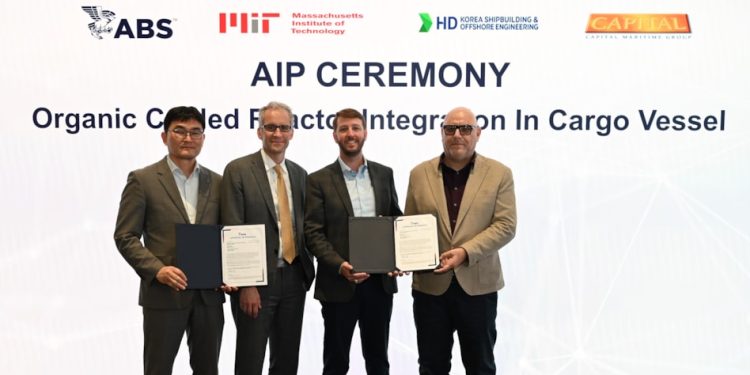
In a significant stride towards the decarbonization of the global maritime industry, ABS has granted an Approval in Principle (AIP) for the integration of a nuclear reactor into a cargo vessel propulsion system. This pivotal announcement was made during the recent Posidonia exhibition (June 1-5), marking a collaborative triumph for the Massachusetts Institute of Technology (MIT), HD Korea Shipbuilding & Offshore Engineering (HD KSOE), and Capital Maritime Group.
The innovative reactor design, developed by MIT, utilizes a specialized synthetic fluid to efficiently transfer heat from the reactor core. Unlike conventional designs, which typically target micro-scale thermal outputs of 10 to 20 megawatts, MIT’s approach boasts near-atmospheric operating pressure. This crucial feature allows for the use of thinner, lighter reactor vessels, significantly facilitating modular construction and simplifying transport logistics – key factors for widespread adoption in **sustainable shipping**.
“The MIT reactor design is an interesting piece of technology. With characteristics that can support modular fabrication and vessel integration, these emerging technologies represent one possible pathway toward the safe, practical development of next-generation commercial shipping solutions,” stated Patrick Ryan, ABS Senior Vice President and Chief Technology Officer, underscoring the potential for **maritime innovation**.
This AIP is the inaugural approval granted through the MIT Maritime Consortium, a pioneering alliance where ABS, HD KSOE, and Capital Maritime Group serve as founding members. ABS meticulously reviewed the reactor-to-machinery interface, ensuring compliance with stringent class requirements.
As global environmental regulations continue to tighten, the maritime sector is under immense pressure to find **paradigm-shifting solutions**. “Nuclear energy represents one of the most promising alternatives to traditional fossil fuels,” commented Sangmin Park, Senior Vice President at HD KSOE and Head of Green Energy Research Laboratory, highlighting the urgent need for **green energy** in shipping.
The consortium’s mission is to bridge the gap between academia and industry, accelerating technologies that promise to reshape the maritime landscape, including alternative fuels, new nuclear technologies, data-driven operational strategies, autonomy, cybersecurity, and onboard manufacturing.
Stergios Stergiou, Chief Sustainability Officer at Capital Clean Energy Carriers Corp., emphasized their commitment: “Through our membership in the MIT Maritime Consortium alongside ABS and HD KSOE, we are committed to ensuring that any pathway to net zero is grounded in the non-negotiable highest standards of crew safety, vessel integrity, and environmental protection. This AIP is the first step in that process.”
Themis Sapsis, Koch Professor of Marine Technology at MIT and Co-director of the Maritime Consortium, added, “Our reactor design is one of the first concrete outcomes of this synergy, providing a realistic pathway towards **nuclear propulsion for commercial vessels**.”
This AIP falls under the purview of ABS’s New Technology Qualification (NTQ) service, a structured framework designed to support the early adoption and implementation of innovative solutions in the maritime domain.
In a related development during Posidonia, Lloyd’s Register also announced a partnership with South Korean shipbuilding, marine services, and nuclear research organizations to advance a new concept for nuclear-assisted car carrier vessels, signaling a broader industry trend towards **future shipping** powered by advanced nuclear technologies.
#NuclearPropulsion #MaritimeDecarbonization #SustainableShipping #GreenEnergy #ABSCertification #MITInnovation #Posidonia #FutureShipping #CleanEnergy #ShipbuildingTechnology