The Strait of Hormuz, a vital artery for global oil shipments, has officially reopened for commercial traffic following the signing of a U.S.-Iran memorandum of understanding (MoU) on June 17. The immediate aftermath, particularly on June 18, saw a significant surge in maritime activity, with 18 transits recorded – the highest single-window count since the conflict began.
This initial wave of commercial vessels was notably dominated by Chinese-affiliated tonnage, with five out of seven documented first movers linked to China. European, Japanese, and Saudi vessels also featured among the early departures, signaling a broadening, albeit cautious, return of confidence beyond high-risk appetite shipowners. Notably, three Saudi-flagged supertankers, carrying an estimated six million barrels of crude, transited the Strait ‘dark’ (with AIS switched off) in the hours following the agreement.
In parallel with legitimate commercial movements, Iran’s sanctioned oil export network has begun a rapid reconstitution. Days before the MoU, three National Iranian Tanker Company (NITC) vessels ended months-long ‘dark’ periods at Chabahar. Furthermore, six more sanctioned tankers departed long-running anchorages off the Strait of Malacca, heading westbound towards Iran, while additional sanctioned vessels are now approaching the Strait of Hormuz and the Bab al-Mandeb. The simultaneous transit of a ‘zombie vessel’ (without verified ownership or registry) and an IRISL-affiliated cargo vessel underscores Iran’s apparent intent to operate outside international shipping norms.
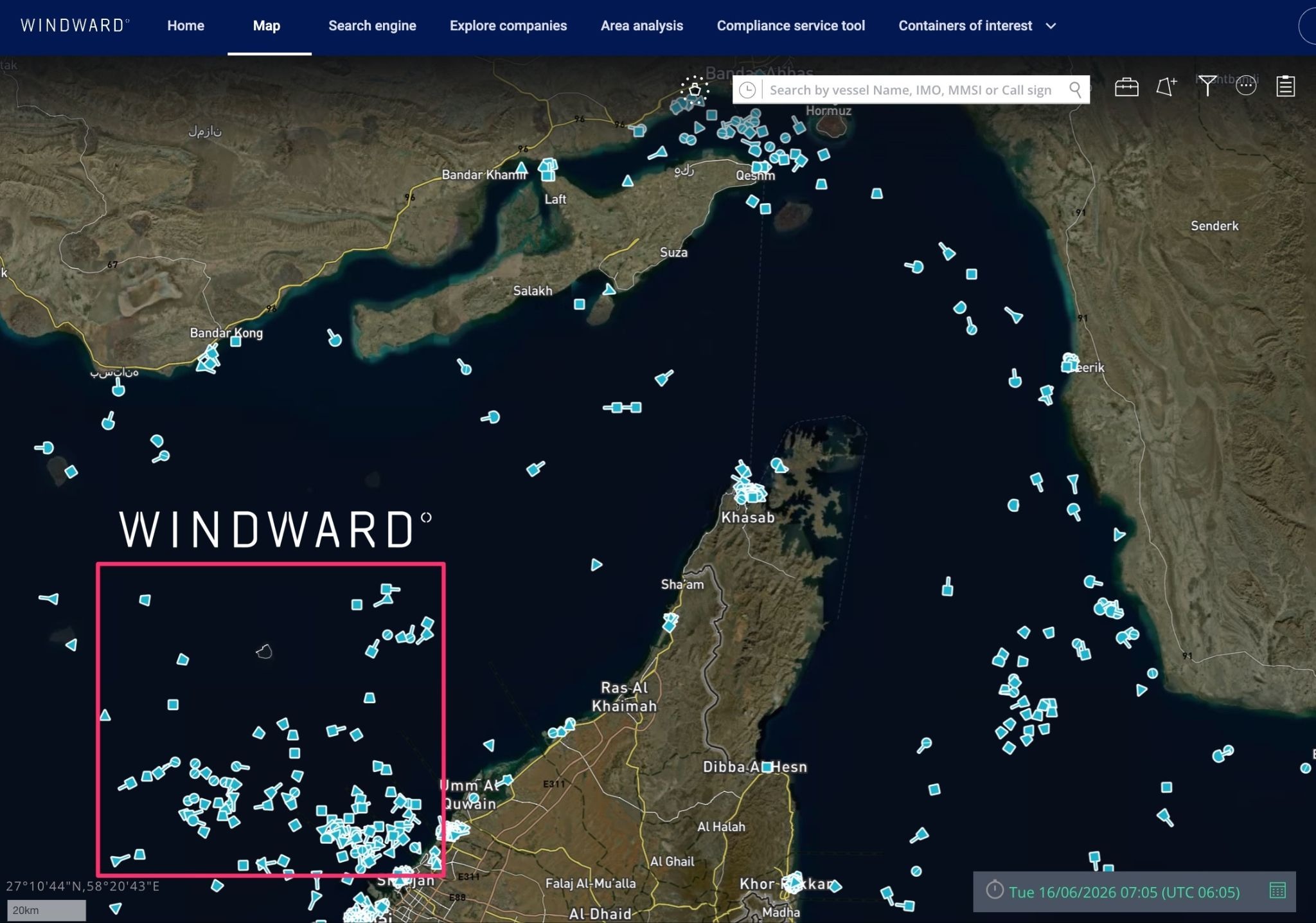
The lead-up to the signing on June 17 saw commercial shipping repositioning, with a cautious uptick in transits and many vessels waiting at anchor, often with AIS switched off. Over 23 Very Large Crude Carriers (VLCCs) converged on UAE ports, and satellite imagery revealed 128 vessels at Khor Fakkan anchorage, with many preparing for departure. Iran’s fleet, however, did not wait, with NITC vessels reactivating AIS and sanctioned tankers breaking a U.S. blockade.
Despite the reopening, the operational environment remains complex. More than 80 IRGC high-speed craft were observed moving in an unusual, undirected pattern through the Kharg Island waiting area, a behavior not previously recorded. The CMA CGM SAN ANTONIO, a container ship boarded and looted by IRGCN small craft in late May, remains stationary mid-Strait. Moreover, the critical Traffic Separation Scheme, the primary shipping lane, remains uncleared of mines, with no minesweeping operations yet underway.
Windward assesses the June 18 picture as one of cautious momentum rather than full normalization. The simultaneous movement of legitimate commercial traffic, reconstituting sanctioned vessels, and unresolved military activity indicates that while the Strait of Hormuz is reopening, the full post-conflict operational risk environment will take weeks, not days, to settle. The return to a stable, predictable maritime corridor is still a distant prospect.
#StraitOfHormuz #USIranMoU #OilExports #MaritimeSecurity #IranSanctions #GlobalShipping #EnergyMarkets #ChinaTrade #SaudiOil #Geopolitics