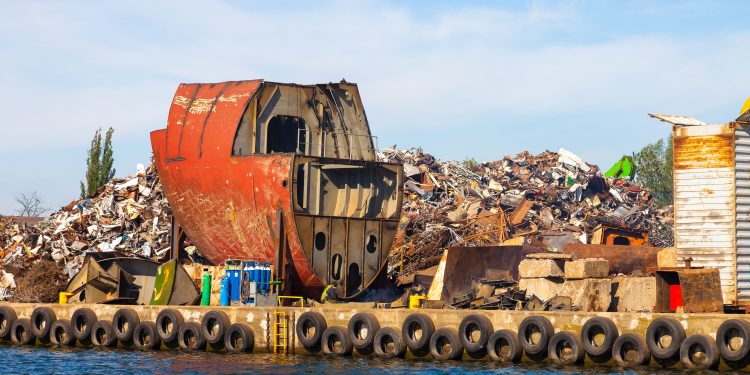
The **Sustainable Shipping Initiative (SSI)** is sounding the alarm, urging regulators to resolve a long-standing governance deadlock between the **Hong Kong Convention (HKC)** and the **Basel Convention**. This impasse, ongoing since 2011, has significantly stalled responsible investment in the crucial **ship recycling** sector, a situation SSI argues lacks sufficient justification.
### Urgent Call for Regulatory Clarity
Ahead of the Basel Convention’s OEWG-15 meeting, scheduled for June 23-26, 2026, SSI is advocating for the **International Maritime Organization (IMO)** to assume the role of the central technical authority for HKC-related work. This move aims to streamline processes, moving away from the current fragmented parallel systems. Furthermore, SSI proposes the establishment of a joint technical workstream, linking the IMO’s experience-building efforts under MEPC 83 with Basel’s analytical work, all in preparation for COP18 in 2027.
### Alang Study Provides Crucial Evidence of HKC Effectiveness
A pivotal factor driving SSI’s stance is new research from its May 2026 study conducted at an **HKC-certified facility in Alang, India**, the world’s largest **ship recycling hub**. The study, titled “Alang in Transition: From Compliance to Capability,” delivers a stark warning: as global vessel retirements are set to surge in the coming decade, the industry must simultaneously enhance **safety standards** and expand **dismantling capacity** without compromising either safety or capability.
Crucially, the research concludes that **HKC compliance** is yielding measurable improvements in both safety and **environmental performance**. This includes stronger **risk controls** across various recycling stages and more structured operational oversight. SSI highlights this as the first independent operational evidence demonstrating the HKC’s practical effectiveness, effectively addressing earlier doubts that contributed to the stalled agreement at Basel COP10 in 2011.
Ellie Besley-Gould, chief executive of the Sustainable Shipping Initiative, emphasized the urgency: “With more than 16,000 vessels coming to the end of life this decade, the cost of another deferral is not abstract. Investment in the knowledge systems, digital infrastructure and downstream accountability that safe scaling requires is being held back. A further deferral at OEWG-15 pushes that back by at least two years.”
### Surging Demand Highlights Investment Imperative
The report underscores the immense future pressure on the sector, projecting over 16,000 vessels to reach end-of-life this decade – more than double the previous ten years. Major facilities like Alang are expected to scale significantly to meet this demand. SSI warns that ongoing **regulatory uncertainty** is actively delaying vital investment in critical infrastructure, including **digital systems**, **workforce development**, and **downstream accountability**, all essential for safe, large-scale **sustainable ship recycling**.
### Downstream Traceability Remains a Key Challenge
Despite progress, SSI identifies a significant unresolved gap in **downstream material tracking**. While hazardous waste is transferred to local authorities, a comprehensive traceability system following materials through secondary processors and onward waste chains, particularly to e-waste handling, is lacking. This limitation hinders the enforcement of HKC requirements and leaves Basel’s critical role in “environmentally sound management” underdeveloped in practice.
IHM expert Henning Gramann, CEO at GSR Services GmbH, commented in an exclusive interview: “It is a fact that Basel Convention and other regulations have been circumvented since decades, mostly for practical reasons, with hardly any consequence. I don´t see that this will change and it would be a great benefit for all if we can work towards an improved HKC in combination with excluding ships from Basel Convention and Basel Ban Amendment.”
### Favorable Conditions for Resolution
Optimistically, SSI believes conditions for a resolution are now more favorable than in 2011. Most major recycling states are now party to the HKC, and enforcement mechanisms are emerging through IMO and port state controls. SSI also urges the **European Commission** to better align its policies with India’s ship recycling sector, noting that EU listing processes remain stalled despite years of audits. Advancing equivalence criteria at upcoming Basel negotiations, SSI argues, could unlock crucial investment and close remaining **regulatory gaps**, fostering a truly **circular economy** for shipping.
#ShipRecycling #SustainableShipping #HongKongConvention #BaselConvention #MaritimeRegulations #IMO #Alang #EnvironmentalProtection #WorkerSafety #CircularEconomy #MaritimeIndustry